


How?
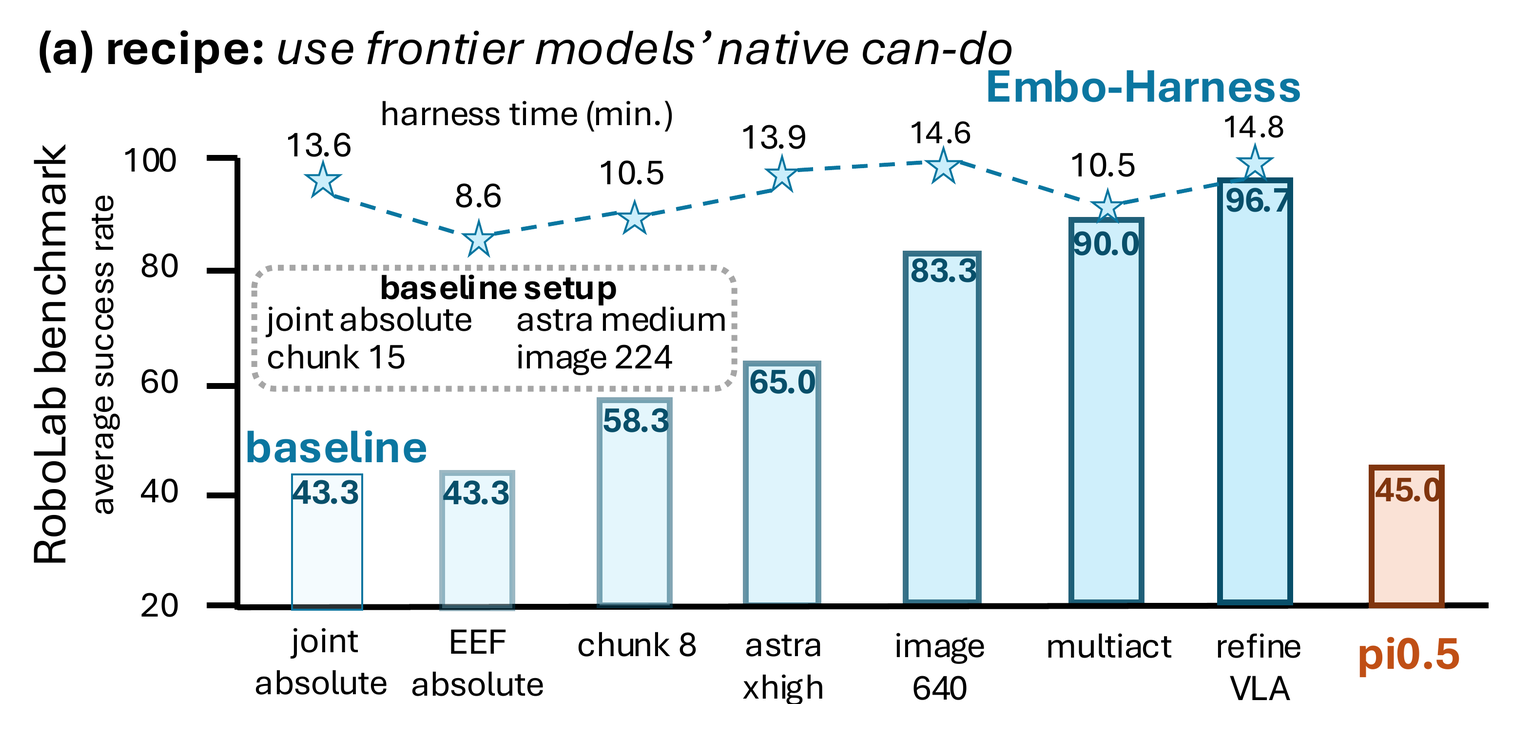
Leverage frontier models’ native capabilities, such as visual perception and tool use, rather than imposing handcrafted priors.
But two fundamental questions remain:
Two Key Takeaways
Leverage frontier models’ native capabilities, such as visual perception and tool use, rather than imposing handcrafted priors.
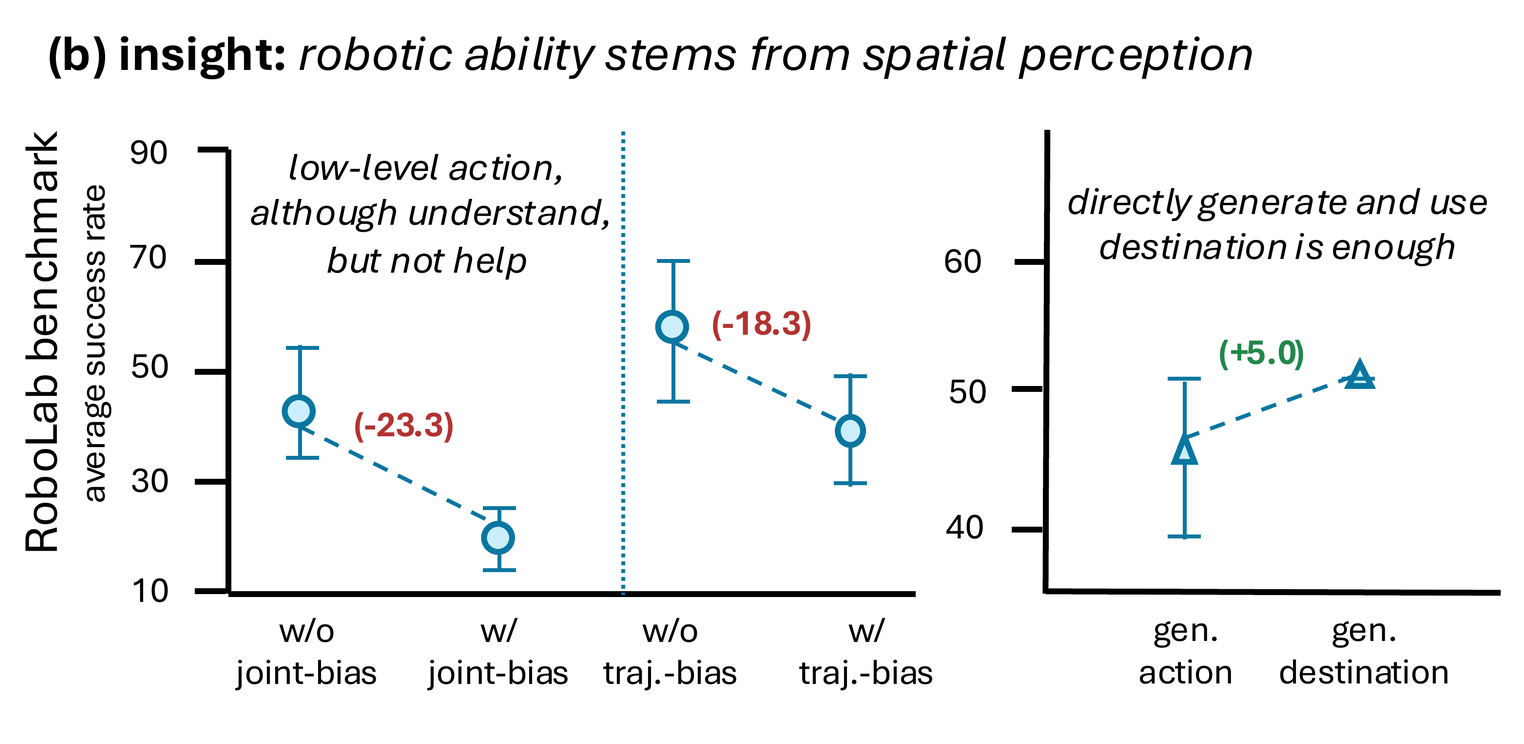
Their remarkable performance is primarily driven by a leap in multimodal spatial perception, rather than low-level action generation.
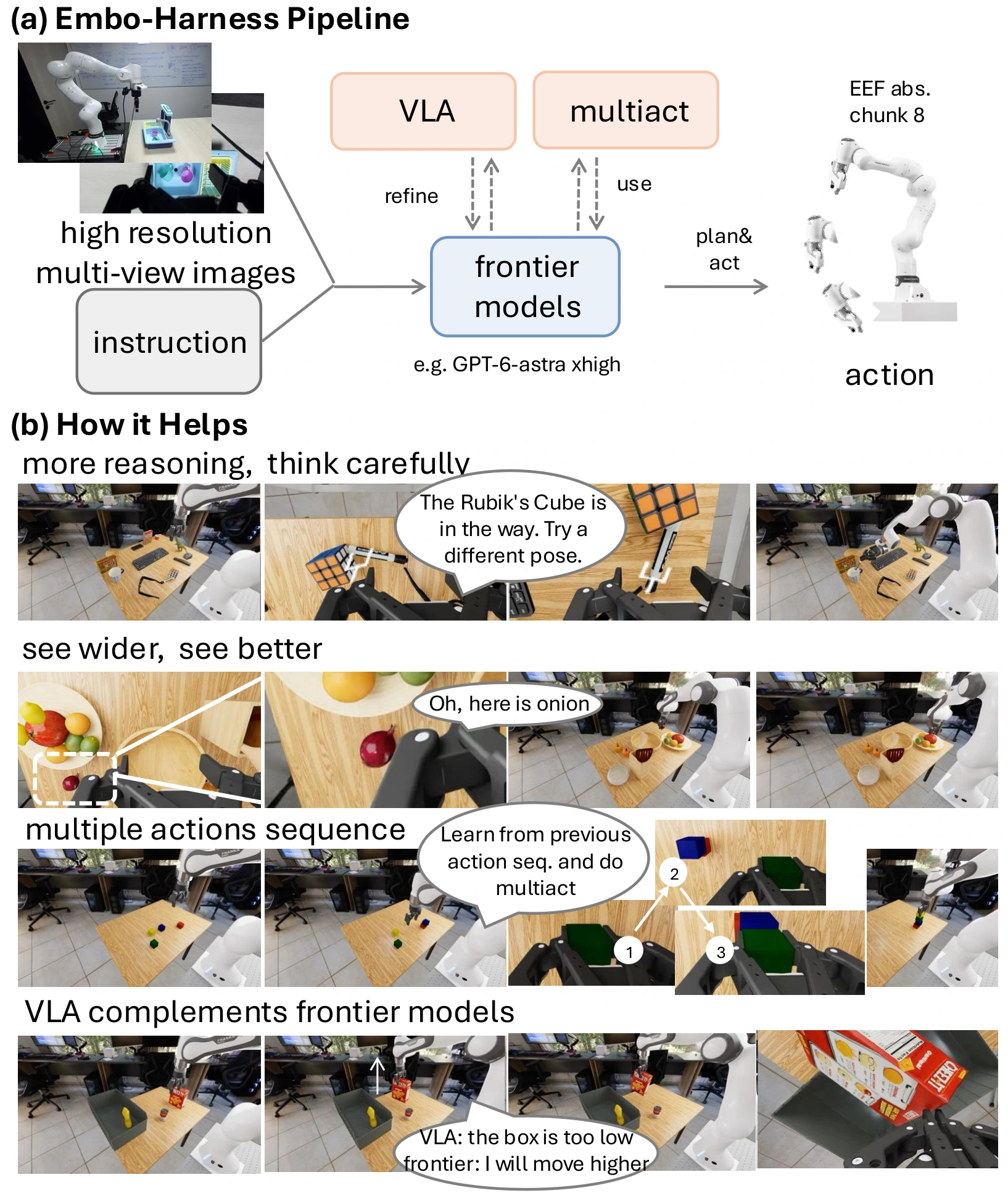
We systematically explore action execution, planning, prompting, and tool use to unlock frontier models’ native capabilities.
| Design choice | SR (%) ↑ | Score ↑ | Time (min.) ↓ |
|---|---|---|---|
| Action space | |||
| Joint absolute | 43.3 | 52.2 | 13.6 |
| Joint delta | 48.3 | 53.8 | 12.1 |
| EEF absolute | 43.3 | 51.9 | 8.6 |
| EEF delta | 45.0 | 51.4 | 9.0 |
| Action chunking | |||
| Chunk 4 | 40.0 | 50.8 | 9.0 |
| Chunk 8 | 58.0 | 68.3 | 10.5 |
| Chunk 15 | 43.3 | 51.9 | 9.0 |
| Chunk 30 | 21.7 | 28.1 | 5.0 |
| Action execution | |||
| Synchronous execution | 58.0 | 68.3 | 10.5 |
| Asynchronous execution | 51.7 | 53.6 | 12.5 |
| Design choice | SR (%) ↑ | Score ↑ | Time (min.) ↓ |
|---|---|---|---|
| Model type and effort | |||
| GPT-6-astra-medium | 58.0 | 68.3 | 10.5 |
| GPT-6-astra-high | 51.7 | 55.6 | 14.5 |
| GPT-6-astra-xhigh | 65.0 | 69.2 | 13.9 |
| GPT-6.1-sol-medium | 40.0 | 44.4 | 12.8 |
| GPT-6.1-terra-medium | 38.3 | 39.7 | 12.1 |
| Planning | |||
| Implicit planning | 65.0 | 69.2 | 13.9 |
| Explicit planning | 61.7 | 65.0 | 16.5 |
| Context | |||
| Full context | 65.0 | 69.2 | 13.9 |
| Cut visual history context | 8× token cost (regenerating KV-cache) | ||
| Design choice | SR (%) ↑ | Score ↑ | Time (min.) ↓ |
|---|---|---|---|
| Prompt | |||
| System prompt only | 65.0 | 69.2 | 13.9 |
| With notice reminder | 60.0 | 60.3 | 15.3 |
| Views | |||
| Two views | 65.0 | 69.2 | 13.9 |
| Single view | 30.0 | 36.4 | 13.1 |
| Visual resolution | |||
| 224 × 126 | 65.0 | 69.2 | 13.9 |
| 320 × 180 | 71.7 | 73.6 | 13.4 |
| 640 × 360 | 83.3 | 86.7 | 14.6 |
| Design choice | SR (%) ↑ | Score ↑ | Time (min.) ↓ |
|---|---|---|---|
| Short action sequence as a tool | |||
| One action at a time | 83.3 | 86.7 | 14.6 |
| With action sequence | 90.0 | 90.0 | 10.5 |
| Policy models as a tool | |||
| Frontier model only | 90.0 | 90.0 | 10.5 |
| Select policy models | 58.3 | 62.2 | 4.4 |
| Refine policy models | 96.7 | 96.7 | 14.8 |
Success rate on RoboLab-120
Over the strongest reported baseline
Zero-shot real-world trials
| Policy | Type | SR (%) ↑ | Score ↑ |
|---|---|---|---|
| Agentic methods | |||
| Embo-Harness | Agentic | 83.3 | 89.2 |
| SenseNova-RoboRSI | Agentic | 57.1 | 69.9 |
| VoLo | Agentic | 28.2 | 44.1 |
| Policy models | |||
| FLUX 3 Action | WAM | 42.9 | – |
| Atomic-WAM | VLM+WAM | 39.6 | 55.5 |
| Cosmos3-Nano-Policy | WAM | 36.8 | 51.9 |
| π0.5 | VLA | 28.0 | 43.4 |
| DreamZero | WAM | 25.7 | 39.8 |
| Cosmos3-Edge-Policy | WAM | 22.9 | – |
| π0-FAST | VLA | 15.5 | 26.9 |
| GR00T N1.6 | VLA | 7.2 | 17.1 |
| π0 | VLA | 5.0 | 12.2 |
| paligemma-binning | VLA | 3.4 | 9.9 |
Four manipulation tasks, without task-specific training, memory, or hints.
| Policy | Block stacking | Fruit packing | Dish washing | Flower arranging |
|---|---|---|---|---|
| Baseline | 4/5 | 3/5 | 0/5 | 0/5 |
| Embo-Harness | 5/5 | 5/5 | 2/5 | 3/5 |
Controlled interventions point to spatial perception as the primary driver of manipulation performance.
Frontier models can generate joint and trajectory actions. Explicitly requiring them to do so reduces manipulation success.
| Policy | SR (%) ↑ | Score ↑ |
|---|---|---|
| Joint bias | ||
| Joint absolute with IK/FK | 43.3 | 52.2 |
| Direct joint absolute | 20.0 −23.3 | 27.2 −25.0 |
| Joint delta with IK/FK | 48.3 | 53.8 |
| Direct joint delta | 16.7 −31.6 | 26.6 −27.2 |
| Action chunk bias | ||
| Chunk 8 | 58.0 | 68.3 |
| Direct chunk 8 | 40.0 −18.0 | 43.6 −24.7 |
| Chunk 15 | 43.3 | 51.9 |
| Direct chunk 15 | 33.3 −10.0 | 36.7 −15.2 |
Predicting the final end-effector destination outperforms short-range action generation.
| Policy | SR (%) ↑ | Score ↑ |
|---|---|---|
| EEF absolute | 43.3 | 51.9 |
| EEF delta | 45.0 | 51.4 |
| EEF destination | 50.0 +5.0 | 55.0 +3.1 |
Stronger reasoning and richer visual inputs improve position estimation, broadly aligning with manipulation performance.
Position estimation errors are comparable to gripper-to-target errors in failed grasps.
| Setting | Average (cm) ↓ | Median (cm) ↓ | ≤ 5 cm (%) ↑ |
|---|---|---|---|
| Model effort | |||
| Medium | 14.10 | 11.24 | 7.4 |
| High | 10.67 | 9.21 | 10.0 |
| Xhigh | 9.07 | 7.04 | 28.1 |
| Visual resolution | |||
| 224 × 126 | 14.14 | 11.39 | 10.0 |
| 320 × 180 | 11.57 | 9.58 | 12.5 |
| 640 × 360 | 9.07 | 7.04 | 28.1 |
| Moving prior | |||
| Normal | 9.07 | 7.04 | 28.1 |
| Moving closer | 7.15 | 5.48 | 48.4 |
| Execution reference · Failed grasps | |||
| Grasp position error | 11.04 | 8.39 | 17.2 |
Tables 4–6 · RoboLab, 20 tasks × 3 runs
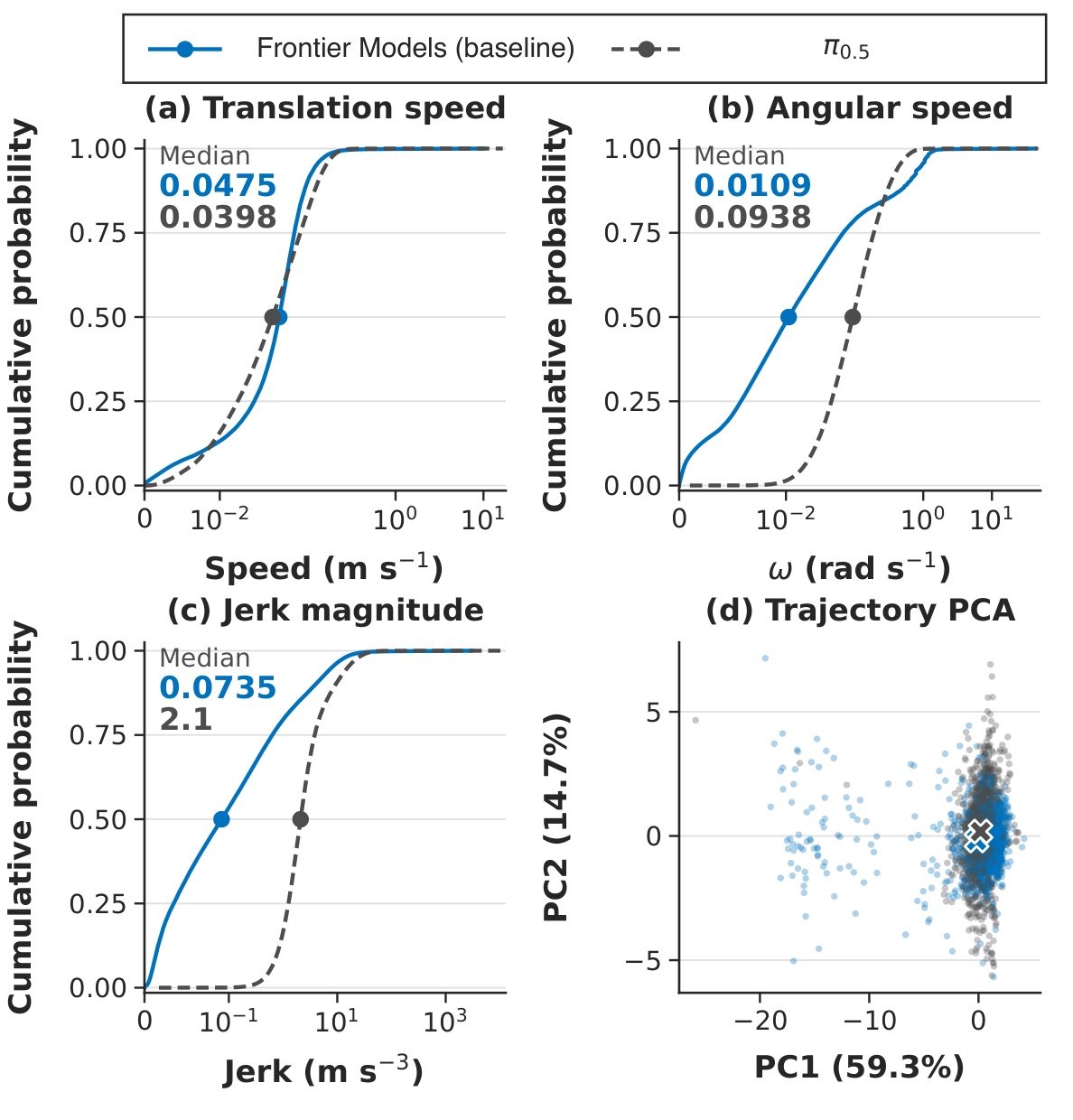
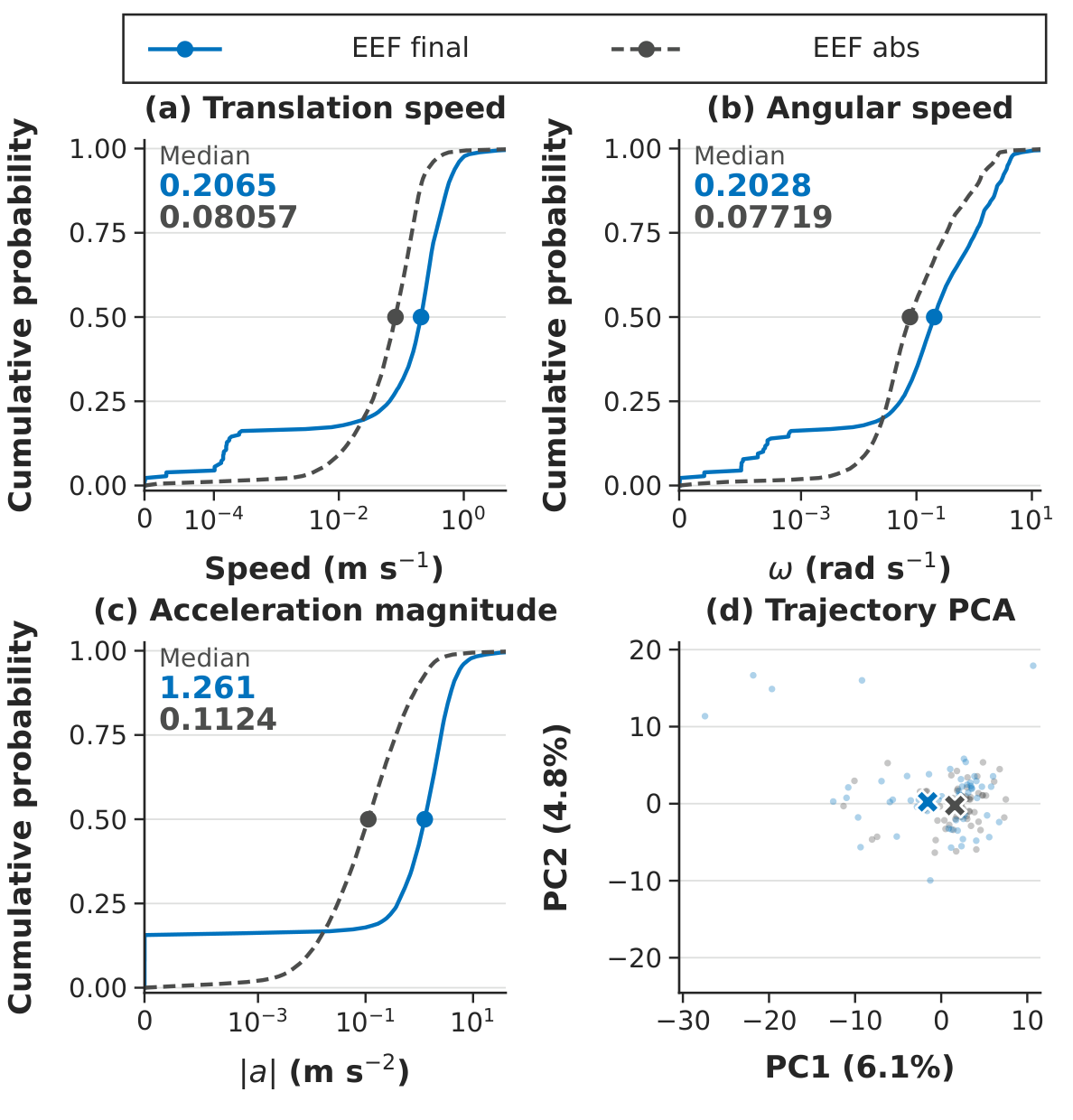
Frontier models’ action trajectories differ from those of conventional VLAs, but closely resemble trajectories generated by directly predicting the EEF destination (only difference is the speed, which is determined by the interpolation strategy).
@misc{wu2026_emboharness,
  title={Embo-Harness: Towards Understanding Frontier-Model-as-Policy Harness},
  author={Xiao-Ming Wu and Kang Liao and Yuexiao Ma and Taolin Zhang and Mingqian Zhou
          and Nuo Chen and Ziming Li and Yihang Luo and Rui Li and Zhonghua Wu and Tianyu Xie
          and Xiawu Zheng and Zhongang Cai and Zhi Hou and Chen Change Loy},
  year={2026},
  eprint={2611.31201},
  archivePrefix={arXiv},
  primaryClass={cs.RO},
  url={https://arxiv.org/abs/2611.31201},
}